The following article is part of a group of posts I made on a Discord server.
Original publication date: 2024-09-13
Variables, Memory, and Types (Part 1 of 3)
A little review of this wouldn’t hurt, especially since in a few weeks we will be starting Java, and the versatility—and in turn, the complexity—will expand.
Variables
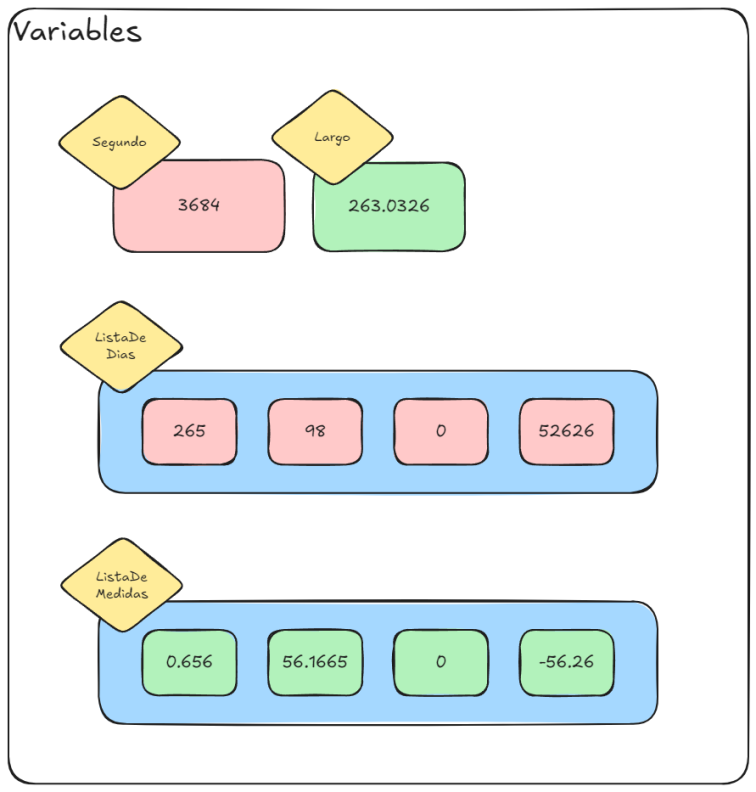
Variables are labeled containers or boxes where we store information that we will require later (image-1), but where do these boxes exist? They exist in memory, whether temporary or persistent, but we will focus on temporary memory where the program will mostly live during its execution.
image-1
Memory
Physical memory is made up of cells that contain a representation of one of two possible states—I’m talking about the bit!
image-2
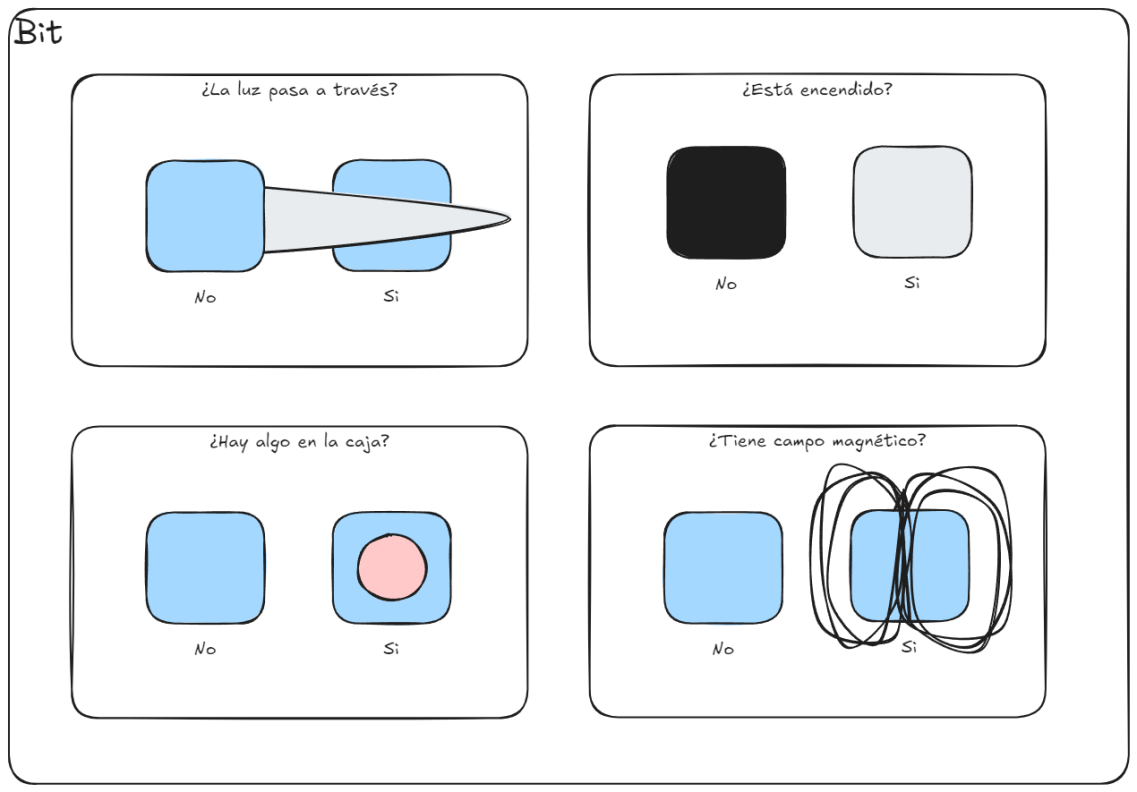
A bit can be represented in many ways (image-2); so far, it doesn’t seem possible to have anything other than True (T) or False (F), but if we group 2 bits, we will have 4 possible states for the set!
- FF
- FT
- TF
- TT
Continuing, 3 bits have 8 possible states, a set of 4 bits has 16 possible states, and so on—for every extra bit, we double the number of possible states. A byte is a set of 8 bits and, based on the above, the set of 8 bits (1 byte) allows for a total of 256 possible states ($2^#Bits).
Going back to the list of possible states with 2 bits, these states are numbered, which means we can use them to count. But to represent 0, let’s shift the list by one, giving FF the representative value of 0 and TT the value of 3. Therefore, with 1 byte, we can represent numbers from 0 to 255 ($2^#Bits - 1).
Where am I going with all this? Because in reality memory only contains states (representing information). So numbers, letters, words and everything else “Do not exist”, but I will go into more detail when I talk about Types